
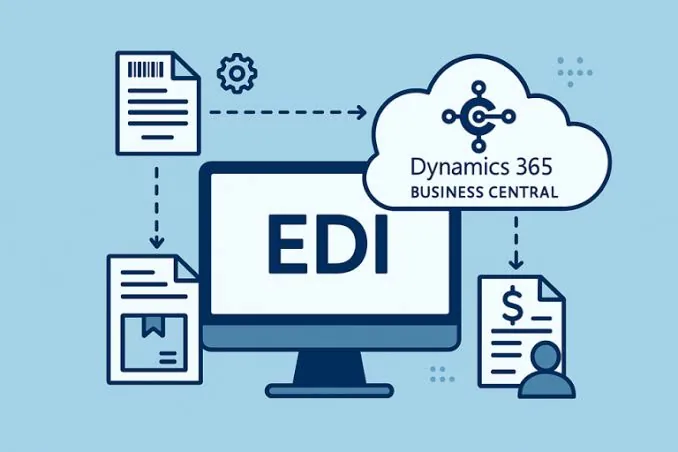
If you've started looking into how to connect your ERP with your customers or suppliers without typing orders in by hand, you've probably come across two terms that get mixed up constantly: EDI and API. They're two different ways of solving the same underlying problem — getting two systems to talk to each other without manual intervention — but they're not interchangeable, and choosing wrong means building an integration that doesn't match what your trading partner actually needs.
The underlying difference
EDI is a closed, standardised format for exchanging specific commercial documents — orders, delivery notes, invoices — in a format both parties have agreed in advance. An API is an open channel through which one system can ask another for any information or action, in real time, without being limited to a fixed catalogue of documents.
Put another way: EDI is like an official form both parties already know and always fill in the same way. An API is more like a conversation with rules: you can ask for different things depending on what you need at any given moment.
Quick comparison
| EDI | API | |
|---|---|---|
| What it is | Standardised format for commercial documents | Real-time communication channel between systems |
| Who requires it | Large retailers, chains, industrial buyers | Marketplaces, SaaS platforms, modern apps |
| What it exchanges | Orders, delivery notes, invoices, confirmations | Whatever data or action the API exposes |
| Speed to set up | Weeks, needs mapping and joint testing | Variable, sometimes faster with a standard connector |
| Flexibility | Low: the format is dictated by the standard | High: adapts to the use case |
When EDI will be non-negotiable
If a large distributor, a retail chain or an industrial customer requires EDI as a condition of working with them, there's no alternative: it's their way of guaranteeing that every supplier delivers information in a single format their system processes without manual intervention. In that scenario, even if you could technically build a custom API, your customer won't accept it: they need EDI because that's how their document-receiving process is built, replicated across hundreds of suppliers at once.
When an API is the sensible choice
When you're connecting to a marketplace, an e-commerce platform or a SaaS tool that doesn't explicitly require EDI, an API is usually quicker to set up and more flexible: you can sync exactly what you need (stock, prices, orders) without being tied to the closed message catalogue a EDI standard imposes. It's also the usual route for integrating online stores with Business Central, as in our Shopify and PrestaShop integrations. That same real-time approach is what keeps stock synced across channels and stops you overselling what you no longer have; and once you've settled on API, the next real decision is whether to use a standard connector or a custom development.
Can the two coexist in the same company?
Yes, and it's common: EDI for the large customers who require it as a condition, and APIs for integrations with your online store, your bank or internal tools. Business Central doesn't force you to pick one route: each connection is solved with whichever technology fits whoever's on the other end.
Frequently asked questions
Is EDI more expensive to maintain than an API?
It genuinely depends on how many trading partners you work with, more than on EDI versus API as a technology choice. A single, well-built EDI connection with one large customer needs barely any ongoing maintenance once it's mapped and tested — it's a stable, agreed format that rarely changes. The cost grows when you have to manage several different partners, each with their own EDI specifications and message versions to keep in sync, but that exact same problem shows up with APIs too if you end up integrating with many different platforms, each with its own authentication method, rate limits and update cycle. In both cases, the real driver of maintenance cost is the number and diversity of connections, not which of the two technologies you're using.
Can I start with an API and move to EDI later if a customer requires it?
Yes, without any problem, and it's actually a very common path as a company grows and starts working with larger accounts. EDI and API integrations are independent from each other at the technical level: adding an EDI connection for a specific large customer who requires it doesn't touch, break or need to be reconciled with the API connections you already have running with your online store, your marketplace or any other system. You simply add the new integration on top, and each one keeps working according to its own logic and its own trading partner's requirements.
How do I know if my case needs EDI or an API?
The question that actually decides it isn't a technical one, it's who's on the other end of the connection. If it's a large retailer, chain or industrial buyer who has already handed you an EDI specification document, there's no real room to choose: you build to their standard, full stop. If instead you're the one deciding how to connect to a marketplace, a SaaS platform or your own online store, and nobody is imposing a fixed document format on you, an API is usually the simpler, faster and more flexible route to build — which is exactly the logic summarised in the comparison table above.
In summary
EDI and API don't compete with each other: they solve different needs. EDI is the standard your large customers will require; the API is the flexible route for everything else. The usual, sensible outcome is ending up using both at once, each where it belongs.
If you're not sure what your case needs, check out our EDI integration for Business Central or tell us who you need to connect with and we'll tell you which route fits.