Products and prices
Your catalog and pricing aligned between the store and the ERP.
Connect your Shopify store with Business Central and sync products, stock, orders and customers in real time, with no manual work.
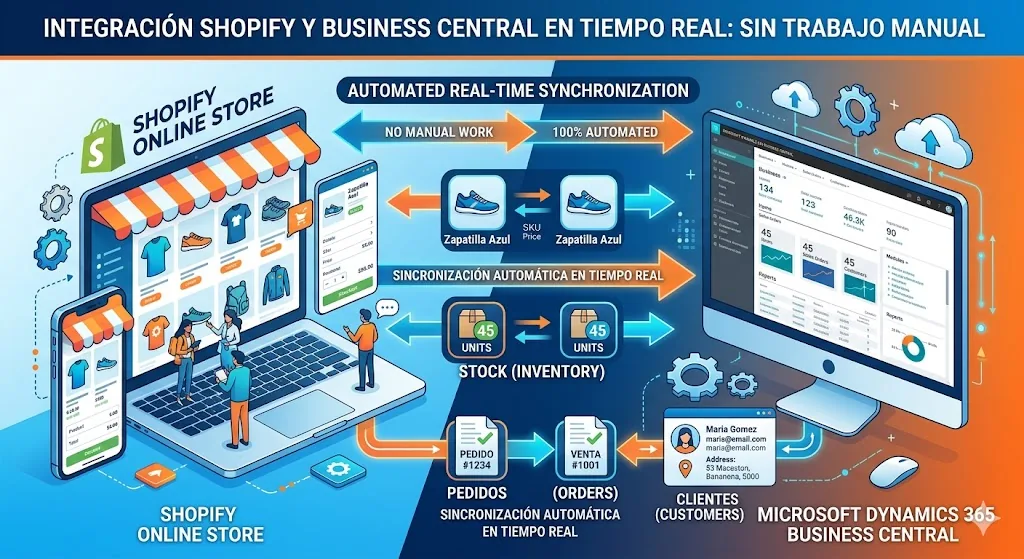
We integrate Shopify with Business Central so your online store and your management speak the same language: stock always up to date, orders that come in on their own and automatic invoicing.
Selling on Shopify and running the business in Business Central with no connection between the two means entering orders by hand, reconciling stock daily and carrying over pricing errors. The integration ends that double work and makes the store and the ERP work as a single system.
Products and pricing stay aligned, stock updates instantly to prevent overselling, and every Shopify order flows automatically into Business Central with its customer and lines, ready to pick, ship and invoice.
Your catalog and pricing aligned between the store and the ERP.
Avoid out‑of‑stock sales: inventory updates instantly.
Store orders flow straight into Business Central.
Customer data and invoices synced, with no duplicated work.
First we define the data map: what information is shared between Shopify and the ERP, in which direction and how often. Every store is different, so the integration adapts to your catalog and your logistics.
Stock and prices travel almost in real time, so the availability customers see on the website matches the reality of the warehouse. Orders flow into Business Central as soon as they're confirmed, with no one having to type them.
We also cover the special cases — new customers, returns, promotions or web-only products — so your daily operations run without surprises and your team can focus on selling.
Products and prices, stock levels, orders and customer data are usually synced, but the exact scope is decided on each project based on how you work: some companies manage the catalogue in Business Central and push it to Shopify, others do it the other way round; some want online store prices to update automatically when the price changes in the ERP, others prefer to keep separate pricing for each channel. It's also decided which direction each type of data flows: stock, for example, almost always flows from Business Central to Shopify (the ERP is the source of truth for real inventory), while orders flow the other way, from the store to the ERP.
Yes. Inventory syncs almost instantly between Business Central and Shopify, precisely to avoid the most common problem of selling without integration: someone buying a product online that you no longer actually have in stock, because it sold through another channel and nobody updated Shopify in time. With the ERP as the single source of truth for real stock — also counting sales in a physical shop or other channels if you have them — Shopify always reflects the correct availability, avoiding sales that later have to be cancelled or delayed, with the resulting bad experience for the customer and the extra work of handling the issue.
Yes. Every order confirmed in Shopify is automatically created in Business Central with its customer (creating a new record if needed), the matching product lines and the shipping details, with nobody having to copy the order by hand from the Shopify dashboard. The order arrives in the ERP already ready for your warehouse team to pick it and for the corresponding invoice to be generated, following the same flow you already use for the rest of your sales. This removes one of the most common bottlenecks when starting to sell online without integration: someone dedicated to copying orders from the store into the management system several times a day, with the risk of errors when transcribing addresses, products or quantities.
Yes. The integration relies on Shopify's official API, which is the same for stores on the standard plan and for Shopify Plus, although the latter usually comes with extra features (such as its own automations or higher order volumes) that are worth considering when designing the integration if you want to take advantage of them. Either way, we don't assume your store works in any particular way: we analyse how your current Shopify is set up — catalogue, variants, shipping methods, installed apps — to size the integration project to your real case, instead of applying a generic template that doesn't fit your store.
No. We work with your existing Shopify store, keeping its design, products and current configuration intact; there's no need to redo anything you already have set up. What we do is configure the necessary connection (through Shopify's API) to sync it securely with Business Central, without touching the visual look or the shopping experience you've already built. This means you can keep using the Shopify apps you already have installed, your visual theme and your current store management processes; the integration adds the connection to the ERP underneath, without interfering with the day-to-day of how you manage the visible part of your online store.
A standard connector or a custom development? The question that actually decides is whether someone has already solved your exact case before.
Read articleOverselling happens when your stock lives in several disconnected systems. The fix isn't counting more often: it's having one single source of truth.
Read articleThe 6 points to check before your Verifactu deadline: from confirming the date to making sure your invoice history stays safe.
Read articleTell us about your project and we'll advise you with no commitment on Business Central, Power BI, Power Platform or Azure.
Request your personalized consultation