
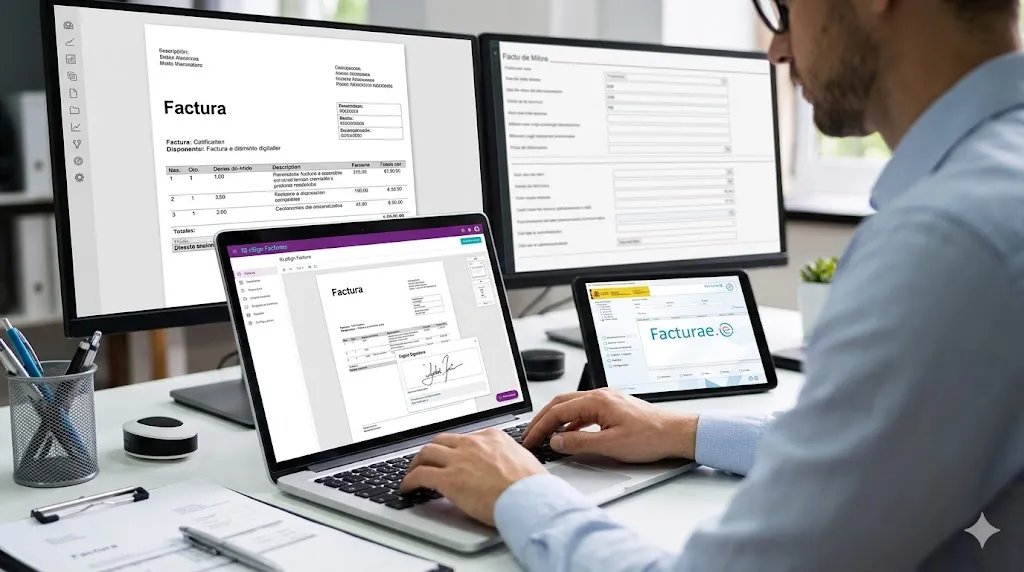
B2B electronic invoicing: what changes with the Crea y Crece Law
Electronic invoicing between businesses has stopped being a recommendation and become an obligation. Law 18/2022 (Crea y Crece) extends to all transactions between businesses and professionals something that, until now, was only required when invoicing public administrations.
If you invoice other businesses, this affects you. A PDF is not an electronic invoice: you need a structured format (Facturae), the ability to both issue and receive, status reporting for every invoice, and proper retention. The technical side is sorted out in weeks; what takes time is cleaning up your customer data.
What electronic invoicing is (and isn't)
The most common misunderstanding: a PDF sent by email is not an electronic invoice. Even if you generate it on a computer and never print it, it's still a document meant to be read by a person.
An electronic invoice is a file in a structured format that the recipient's system can process automatically, with nobody typing anything in. In Spain the reference format is Facturae, an XML with all fields standardised. The difference isn't whether paper disappears — it's whether the system on the other end can read the invoice without human help.
PDF by email
A document meant to be read by eye. It isn't structured and can't be processed automatically.
Facturae (XML)
A structured file with standardised fields that the recipient's system reads without manual intervention.
Who it affects
Every business and professional in their business-to-business (B2B) transactions. Size doesn't matter: it applies to large companies and to sole traders invoicing another business alike. What changes by size is when it kicks in, since the rollout is staggered. Transactions with private individuals (B2C) are excluded and keep their usual regime.
The timeline
Deadlines are counted from the entry into force of the regulation implementing the law, and they've been adjusted more than once. The general pattern: larger-turnover companies get a shorter deadline, while the rest of businesses and sole traders get extra time.
What it will require in practice
Beyond the format, the regulation aims to tackle late payment. That's why issuing the file isn't enough on its own:
Issue in structured format
All your B2B invoices in structured format (Facturae).
Be able to receive
Be able to receive them in that format too, not just issue them. The part many overlook.
Report status
Report whether each received invoice is accepted, rejected or paid. This is the key to controlling late payment.
Retain
Guarantee their authenticity and integrity for the legally required period.
Facturae and FACe: who's who
Two terms that are often confused:
Facturae
The structure of the invoice's XML file.
FACe
The General State Administration's invoice entry point, where invoices are submitted to the public sector.
How to get ready
-
1
Check what your system does today
Does your software generate Facturae? Does it sign digitally? Can it receive structured invoices from your suppliers? The answer tells you how much work lies ahead.
-
2
Review your master data
The single biggest cause of delays. A structured format doesn't forgive mistakes: if a customer is missing their tax ID or has the wrong fiscal address, the invoice gets rejected. Cleaning up your customer database now saves you fires later.
-
3
Get your digital certificate
You'll need a valid certificate to sign with. If you already have one, check its expiry date: renewing it while invoices are stuck isn't a good plan.
-
4
Decide where the process lives
You can export invoices to an external tool, or integrate the whole cycle into your ERP. The second option avoids shuffling files around and keeps traceability in one place: what was signed, when it was sent, and what state each invoice is in.
Frequently asked questions
Does a digitally signed PDF count?
Not for the B2B requirement. The signature provides authenticity, but the PDF still isn't a structured format the recipient can process automatically.
I invoice very little, does this still affect me?
Yes. The requirement doesn't depend on volume: if you invoice another business or professional, it applies to you. Volume only affects the date from which it kicks in.
What if my customer isn't ready?
The requirement applies to both parties, so sooner or later they will be. In the meantime, the sensible approach is to be able to issue in both formats during the transition, rather than waiting for the other side to move first.
How long does it take to be ready?
The technical side is sorted out in weeks. What takes time is cleaning up customer data and adjusting internal processes. That's why it's worth starting there instead of leaving it for last.
Electronic invoicing is not the same as Verifactu
The Crea y Crece Law regulates the format you use to invoice other businesses (Facturae, structured, with tracking of each invoice's status). Verifactu is a separate, independent requirement: it regulates how your billing software itself must behave —traceability, chained hash and QR code on every invoice—, and it applies to any invoice, whether issued to a business or an individual. You can be affected by both at once, but each one demands something different from your system.
If you want to understand the other requirement in detail, we have a complete guide on what Verifactu is and how it works, the updated timetable with the Verifactu deadlines for 2027, and a checklist of the points to check before your deadline.